Who Makes the Team? Putting School Sport Under Pupil Scrutiny
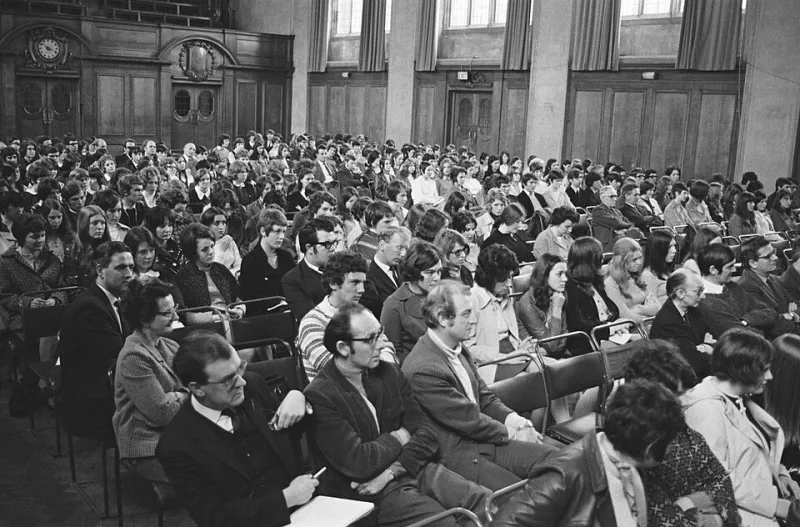
Photo: Geoff Charles, CC BY-SA 4.0, via Wikimedia Commons
Ask a headteacher who decides what counts as sport in their school and the answer will usually be “the timetable”. Ask a pupil and the answer is more likely to be a named member of staff. Both are answering accurately, and both answers are incomplete. The curriculum sets the frame; a single teacher, coach or business manager fills it in. That is why the team sheet deserves to be read the way we read a policy document: as a record of decisions, made by someone, with consequences for everyone else.
A policy document in disguise
Nobody drafts a policy that says the same eleven children will represent the school in every sport for five years. Yet that is often the effect of accumulated selection choices, and effects are what pupils experience. Over a season, selection allocates something genuinely scarce: minutes on a pitch, a seat on a coach, a line on a college application, the standing that comes from being named in assembly.
Three things usually escape scrutiny. First, who is consistently not picked, and whether the reasons are ever recorded. Second, which activities the school counts as sport at all — is dance counted? Skateboarding? Walking? The answer determines who gets the hall on a Wednesday. Third, who pays, in money and in time, for the privilege of representing the school.
Four questions the council should own
A sport audit does not need a consultant or a data analyst. It needs a small group of pupils, an hour a fortnight, and a willingness to ask the same question about several different activities.
| Area | The question | The evidence |
|---|---|---|
| Access | Who can reach practice without a lift, a fee or a missed bus? | Club registers, start and finish times, travel arrangements |
| Facilities | Which groups lose the hall, the field or the pool when something else needs it? | Room bookings, timetables, lettings records |
| Selection | How are teams chosen, and is that written down anywhere? | Trial criteria, selection notes, squad lists over three years |
| Cost | What does a term of school sport cost a family? | Kit lists, trip letters, voluntary contribution requests |
Each column is auditable. None of it requires confidential information about individual children; aggregate figures and anonymised registers will do.
The hidden invoice
The cost question is the one councils most often skip, because sport is assumed to be free at the point of use. It rarely is. There is the compulsory PE kit with a branded top, the football boots for a school that only plays on grass, the £40 coach to an away fixture, the “voluntary” contribution that nobody quite calls compulsory. Add the transport home after a 4.30pm finish, and participation becomes a household budgeting decision.
Pupils are well placed to document this because pupils are the ones who quietly drop out. A short anonymous survey — what have you stopped doing, and why — will usually produce more useful intelligence than a year of staff meeting speculation.
Facilities are a democratic question too
The allocation of the sports hall is a small study in power. Competitive teams tend to win the prime slots because fixtures are fixed and leagues are unforgiving. That is a legitimate claim, but it is a claim, not a law of nature. A council that maps hall use across a fortnight will often find that the largest single block of time goes to the smallest group of pupils. Governors should want to know that, and pupils should be the ones telling them.
Running the audit in a term
- Weeks one to two: agree the scope with the head of PE and the link governor. Ask for aggregate data, not personal files.
- Weeks three to five: run the pupil survey in tutor time, with a paper option and a version in the languages the school actually uses.
- Weeks six to eight: interview three or four pupils who have stopped taking part. Their accounts are the most valuable evidence in the whole exercise.
- Weeks nine to ten: draft a two-page summary with three recommendations — no more than three, or nothing will happen.
- Week eleven: present to the governing body's curriculum committee as a standing item, not as a courtesy performance.
What governors should do with the answers
Primary schools already publish how they spend the PE and sport premium; the reporting is frequently thin, listing equipment rather than impact. A pupil audit gives that document something it usually lacks: an account of who benefited. Secondary schools have no equivalent duty, which makes the case for a voluntary annual sport statement stronger, not weaker.
The modest ambition here is not a revolution in school sport. It is that a child who is never picked should be able to find out why, in writing, from an adult who has thought about it — and that a council should be able to show the governing body where the hall goes on a Wednesday and who never gets a seat on the bus.