Beneath the No Ball Games Sign: A Democratic Settlement for Break Time
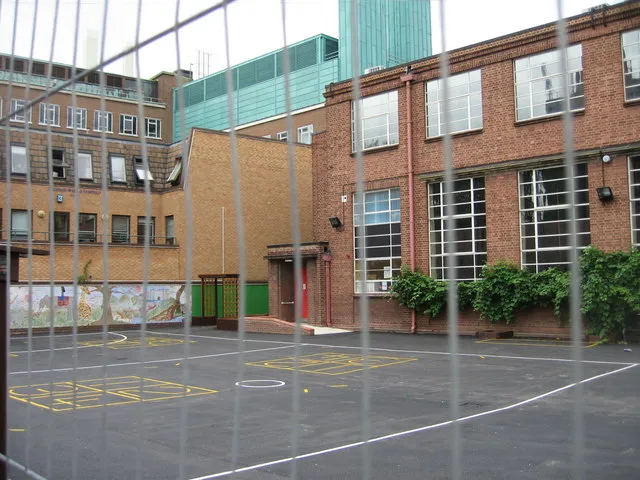
Photo: Sebastian Ballard, CC BY-SA 2.0, via Wikimedia Commons
Walk into almost any UK primary or secondary school at morning break and you will find a small polity at work. Pupils negotiate possession of the football pitch, invent games in the corners of the yard, queue for the climbing frame, patrol the edges of the buddy bench and test the patience of duty staff. It is noisy, improvisational and largely self-organising. It is also, almost everywhere, governed by a set of rules that pupils had no hand in writing.
The signs are familiar: no ball games, no running, keep off the grass, one way only. Equipment is issued from a locked cupboard at the discretion of an adult. Zoning plans are drawn up in staff meetings. The buddy bench, that well-meant artefact of inclusion, is often installed without asking the children who might use it what they actually need. Break time is the only substantial stretch of the school day in which pupils organise themselves, and yet it is one of the most tightly regulated by adult decree.
This is not a trivial matter of playground management. It is a question of governance. If schools are serious about pupil voice, they cannot confine it to a student council that meets once a fortnight and debates the colour of the noticeboard. The playground is where pupils practise the habits of civic life: sharing space, settling disputes, including outsiders, adapting rules to circumstances. A school that governs break time entirely from the staffroom teaches pupils that authority is something done to them. A school that shares that authority teaches something more durable.
The most governed ungoverned hour
Break and lunchtime occupy a peculiar place in the school day. They are formally unstructured, yet densely rule-bound. They are supervised, but lightly. Duty staff are expected to maintain safety and order without the detailed policy apparatus that governs classrooms. In primary schools, lunchtime supervisors often carry the heaviest responsibility with the least formal authority. In secondary schools, the yard can become a contested space where older pupils dominate equipment and younger pupils retreat to corridors. The result is a regime that is simultaneously over-regulated and under-legitimated.
Pupils know this. Ask a Year 5 class why they are not allowed to play football in the small yard and they will tell you it is because of the windows. Ask a Year 9 tutor group why the basketball court is closed at lunchtime and they will say it is because of behaviour last term. These are rational explanations, but they are not democratic ones. The rules may be sensible. They may even be necessary. But they have not been tested in the only forum where their legitimacy matters: the consent of the governed.
The cheapest reform available to any school is not a new building or a new curriculum programme. It is a written settlement between pupils and staff about how the playground is run. Call it a playground constitution.
What pupils already know about the rules
A playground constitution should begin with evidence. Pupils are unusually well placed to map the actual life of the yard. They know which zones are crowded, which equipment is hoarded, which games exclude, which corners feel unsafe, which duty staff are trusted and which are avoided. They know that the no ball games sign has pushed football into the corridor. They know that the buddy bench is used by pupils who want to be seen to be kind rather than by pupils who need company.
Gathering that evidence need not be elaborate. A simple playground audit, conducted by a mixed group of pupils from different year groups, can record how space is used at different times, where conflicts arise and which rules are widely understood. A short survey or circle discussion can test whether existing rules are known, fair and enforced consistently. The point is not to replace professional judgement with pupil preference. It is to ensure that professional judgement is informed by the lived experience of the space.
A playground constitution: five articles
A workable model needs to be short enough to be read and specific enough to be binding. Five articles are enough to begin.
First, zones. The playground should be divided by agreed purpose rather than by adult intuition: active play, quiet play, social seating and a circulation route. Pupils should propose the boundaries, subject to a risk assessment by staff. Second, equipment. Equipment rotas should be co-designed, with clear rules on sharing, storage and damage. Third, games. Where a game is restricted, the restriction should be written down with its reason and reviewed termly. Fourth, conflict. A pupil-led resolution process, with adult support where needed, should handle disputes before they become behaviour incidents. Fifth, review. The constitution should be revisited each term by a playground council with real authority to propose changes to governors.
The constitution should be ratified by the governing body or trust board, not simply agreed in a staff meeting. That gives it standing. It also makes clear that pupil authority is not a favour granted by an individual teacher but a settled part of the school's governance.
Safeguards that make authority safe
None of this requires schools to abandon their safeguarding duties. A playground constitution must sit within existing child protection, health and safety and behaviour policies. Safety is not negotiable, and pupils should be told so plainly. But safety is not the same as adult control of every decision. A risk assessment can set boundaries within which pupils exercise judgement. Duty staff can retain the authority to intervene in an emergency while being accountable for how they exercise routine authority.
Inclusion needs particular care. A playground democracy can easily become a tyranny of the majority, especially where older or louder pupils dominate. The constitution should therefore include minority safeguards: a quiet zone that cannot be reassigned without consultation, a guarantee that equipment is available to all year groups, and a route for pupils who feel excluded to raise concerns without public confrontation. Buddy benches should be redesigned with the pupils who use them, not merely installed as a symbol.
The cheapest civic reform
Schools are constantly told to do more civic education. They are urged to teach British values, promote fundamental British values, run mock elections and invite in local councillors. All of that has its place. But the most authentic civic education a school can offer is already happening at break time, and it costs almost nothing to democratise.
A playground constitution will not solve every behavioural problem. It will not eliminate conflict, and it will not make duty staff's job effortless. But it will give pupils a real stake in the space they inhabit, and it will give staff a legitimate framework for enforcing rules that pupils helped to write. It will also teach the oldest lesson of democratic life: that authority is strongest when it is shared, and that the first parliament a child ever encounters should not be a noticeboard in the corridor.
Schools that want to begin can start small. Pick one playground. Convene a mixed group of pupils. Ask them what the rules are, who made them and what they would change. Write it down. Ratify it. Review it. The cost is a few hours of staff time and a laminated copy on the wall. The return is a generation of pupils who know what it feels like to govern, and to be governed well.